
AI Won't Replace Developers. It'll Replace Bad Managers.
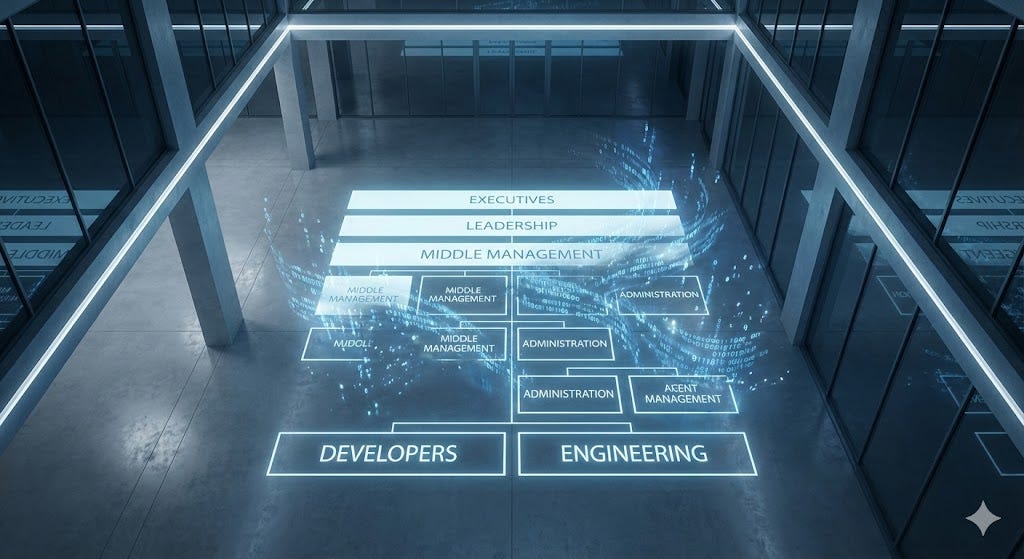
The real disruption in tech isn't happening on the engineering floor, it's happening one layer above it.

Every LinkedIn thought leader is worried about the wrong person.
The narrative is familiar: AI writes code now, so developers are next on the chopping block. GitHub Copilot. Cursor. Claude. The headlines practically write themselves, “Is your software engineer obsolete?”
They’re asking the wrong question.
The real disruption isn’t happening on the engineering floor. It’s happening in the layer above it.
The Middle Manager’s Real Job Description
Here’s what a mid-level engineering manager actually does all day: coordinates information between teams, translates business requirements into tasks, tracks who’s blocked on what, reports upward, shields teams from noise, and follows up on things that should have been done last Tuesday.
Notice anything? None of that is uniquely human. All of it is pattern recognition, communication, and routing - the exact things AI does well.
The developer writes the thing. The manager coordinates the people writing the thing. AI is now very, very good at coordination.
The Numbers Tell the Story
McKinsey’s latest research puts 30% of current work hours in the U.S. as automatable by 2030. But look at which tasks: scheduling, reporting, information synthesis, meeting summaries, status updates. That’s not a developer’s job description. That’s a manager’s.
Meanwhile, demand for software engineers is still projected to grow 25% over the next decade. Demand for middle managers in tech? That projection gets quieter every quarter.
The Champagne Problem
For the last decade, companies hired layers of management to handle the complexity of scaling software teams. It was an expensive but necessary tax on growth. A senior engineer couldn’t spend all day context-switching between Jira, Slack, stakeholder meetings, and roadmap reviews. So you hired someone to absorb that chaos.
AI just made that tax optional.
Tools like Linear + AI can auto-prioritize backlogs. Meeting bots summarize decisions and assign follow-ups. AI project managers can flag blockers before a human even notices them. The coordination overhead that justified an entire layer of org chart is quietly being automated away.
What This Means for Your Career
If you’re a manager who spends most of your time routing information, be honest with yourself: that’s the job that’s disappearing.
If you’re a manager who spends your time making hard calls, protecting your team’s focus, spotting talent, and setting direction - AI makes you more valuable. You’re freed from the coordination tax and left with the work that actually requires judgment.
The developers who are thriving aren’t the ones who ignored AI. They’re the ones who picked it up and doubled their output. The managers who will thrive are the ones who evolve from coordinators into decision-makers.
The disruption isn’t coming for the people who build. It’s coming for the people who mostly just pass messages between the people who build.
The Bottom Line
The org chart is getting flatter. Fast.
AI isn’t killing the builders. It’s killing the middlemen. And in most tech companies, there are a lot of middlemen.
The question isn’t whether your job can be automated. The question is whether, if you stripped away every meeting, every status update, and every Slack relay, anything would be left.
If the answer makes you uncomfortable, that’s the point.
Thanks & bye!
Yulia